What is ERP? Importance & Advantages of ERP Software System
We are discussing about what ERP is, where it is being used and what its use is. The expansion of ERP is Enterprise Resource Planning. Gartner Group was the first to use this term in 1990’s, even though the ERP development was being taken place. This article provides details about the introduction, importance, advantages and features of an ERP software. I hope this guide will be beneficial for beginners, who want to know about ERP system.
Enterprise Resource Planning is the centralized product that synchronizes and integrates all functionalities and departments in a Company. Such single product that handles all functionalities is called ERP system. It deals with all wings such as production, purchase, sales & distribution, accounting, human resources etc. and integrates all of them and dealt under a roof, that is ERP software. Such integrations efforts were happening from 1960’s.

In early days, while software evolved, each department started developing software for that particular department but it did not have any connection with the next department. Thus in case of contacting or coordination with other departments, this software was of no use, it had to be done manually. Here came the need for ERP software, where all these could happen in a single frame. Thus after Gartner group in 1990’s paved way for the revolution of ERP software.
Importance of ERP software
Let’s now look into how ERP software is important in a Company. We shall put it up with an imaginary Company. In a product manufacturing company named X, what all functionalities shall be present? It will have a production unit, where products manufacturing take place.
In order for production, raw materials have to be purchased. An operations department works for handling these raw materials, storing it in warehouse space and for knowing the balance of raw materials etc. the goods once produced shall be stored in another warehouse.
To market these finished goods they shall have a sales and marketing department. They may also have outlets to sell the products and an accounts section for handling the expenditure, income etc. in addition will have an human resources department for recruitment of staff, payroll, welfare of employees etc.
There are lot of difficulties in the absence of ERP software that integrates the communication of the departments. The coordination between these independent departments or functionalities shall be very complicated, slow, time consuming and inefficient.
For example; while marketing the product the team need to have an understanding of the stock available in the warehouse and thus need to contact the warehouse department. Likewise, the production team need to know the stock of raw materials by contacting the raw materials warehouse team and the accounts department need to contact each department for smooth functioning as they need to understand the cost of production, raw material purchase bill, cost of sale and marketing , their billing, sale etc.
Above all, the managerial heads need to have an understanding of the status of each department to take a decision. In such cases they had to literally break their head on the reports from each department, analyse those, study and verify these reports to reach a conclusion.
This complexity calls for the relevance of ERP software. The main advantage is that the ERP has a centralized storage of data. All data of each department such as HR, Sales & Marketing, purchase, accounts etc shall be stored in a single centralized database.
Thus all those functionalities that are interconnected gets to avail all data that are necessary for their functioning within a short time from the system if ERP software is implemented. Thus manual coordination is no more required in such instances and thus they are all so quick and thus save a lot of time.
It improves the efficiency, accuracy, profitability, productivity of a Company since consolidated, accurate data in readily available easily. The management also will have easy handling of data and thus reach real-time, quick and accurate decisions. Thus it the biggest advantage of ERP software.
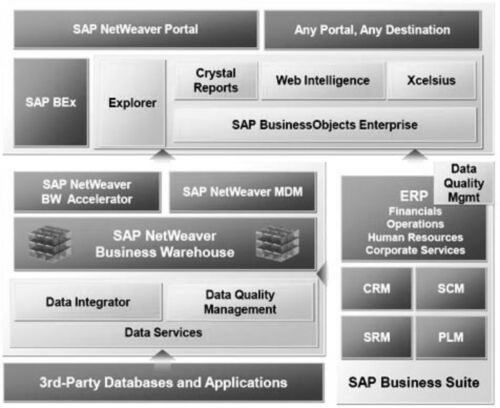
Today, many Companies develop ERP software. The frontline Companies to develop it are SAP, ORACLE, Microsoft NAV Dynamics etc. there are also open source and free software available for small Companies.
Many Companies develop ERP software but mostly they are custom made according to the functionalities, turn over etc in the particular Company. For instance, SAP develops ERP software which is so huge and thus most of the modules of it shall not be useful for a small Company.
Also SAP has highly economical sided software and thus cannot be afforded by such small Companies. Hence such Companies can switch to ERP software developed by small Companies according to the requirement and functionality of the Company.
ERP software being so customizable any Company can afford to use a ERP software according to their budget and functionality.
There are different types of implementation techniques for ERP system
- On-premiise implementation
- Cloud mplementation
- SAAS model
On premise implementation means the software is implemented in all local systems of the Company. In such cases, it shall be accessed only inside that premise. Whereas cloud implementation means it is implemented in Cloud and thus can be accessed from any part of the World. It is the Company’s choice as to which and what has to be implemented. Multiple locations Companies will definitely choose Cloud based implementation for easy access. Certain companies that have sensitive data which cannot afford it to be publically available over the network shall prefer only on-premise implantation. Thus the ERP software implementation is being chosen by the Company according to the data sensitivity and their requirement.
Advantages of ERP
Thus so far we have discussed, about the importance of Enterprise Resource Planning, its use and its evolution and revolution. Now lets us look in to the advantages of ERP software.
- Centralized Data: Centralized database management system is one of the unique and most relevant advantages of ERP software. The data of all functional areas are being stored in a single database. It concentrates on centralized data instead of distributed data.
- Real-time data: Being centralized data storage and stored in database, real time data is available any time. That is the current stock, raw materials requirement etc can be availed real time.
- Cross integrations: Integration between different department and functionalities happens with the use of ERP software without much complexity. It enables proper coordination between them as well.
- Enhanced productivity: Due to real time data availability and proper integration between the functionalities, productivity shall be increased along with efficiency.
- Quick Decisions: As all data are available from all the functionality each department can make quick decisions based on the available data. Even the top management can also make decisions as all real times accurate data from all functionalities are available on their fingertips.
- Accuracy: Except for the human errors made while inputting, the data in the software shall be accurate as no manual calculation or delegation are being made. Data accuracy in this software shall be more accurate comparatively. Hence the decision also implies to be accurate.
- Sales intelligence data or sales forecasting: Almost all ERP software has the option of sales intelligence report and sales forecasting based on the data from all functionality in database. The higher authorities can access such data available to plan the future activities of the Company. The software calculates with all available data to give out accurate sales forecast.
- Financial Control: As all financial reports, data, sales forecast and sales intelligence report are available it is easy to analyse and plan the finance of the Company in a better way. The data will draw the real picture of bad credit, debts, payment dues, financial history etc. to understand the flaws of the Company. Hence a rectification is easy end pulls the Company up in to the proper financial track.
- Multi-nation business: Business in different countries is complex as each country has different tax, different currency etc. making it difficult to codify. It is so hilarious a task when small software handles each country. The brand new ERP software of SAP, Oracle etc. are content to handle these issues so easily, irrespective of the tax variants or currency, the software handles all these to give the Company centralized codified data in a single database.
- Risk reduction: The intelligence data and centralized data enable to rule out the flaws and low performing areas in a Company. It gives out the exact data on plant maintenance, machine maintenance, employee health and all the like data can be analysed through the ERP software. There by the Company having the right warnings then and there, enabling reduction of unexpected risk of wear and tire. It may also give out a market forecast and competitor list to point out the risk involved in that area too. Thus all business related risks shall be identified to an extent with ERP software.
There are abundant numbers of advantages for Enterprise Resource Planning software. We tried to pick the most important ones for your understanding.